Oregon City Concrete Sealing and Waterproofing Guide
Oregon City sits at a point where the Willamette River meets centuries of rainfall, and that combination makes concrete sealing and waterproofing more than a cosmetic upgrade — it is structural maintenance. The Pacific Northwest climate delivers persistent moisture through fall and winter, followed by UV exposure in summer, and concrete surfaces throughout Clackamas County bear the consequences year after year. Driveways crack, foundations allow water intrusion, patios spall, and unsealed flatwork absorbs freeze-thaw cycles that slowly compromise the slab. Understanding how sealing and waterproofing work — and when and why to apply them — puts you ahead of the repair curve.
Why Moisture Is a Primary Threat to Concrete in Oregon City
Oregon City averages over 47 inches of rainfall annually, and the wet season runs from October through May. During those months, concrete surfaces are essentially never fully dry. Water infiltrates the porous matrix of cured concrete, and over time that saturation softens the substrate beneath flatwork, encourages mold and efflorescence, and allows deicing agents — where used — to accelerate surface deterioration.
The freeze-thaw cycle is less severe here than in inland high-elevation climates, but it is not absent. When temperatures drop below freezing overnight and rise during the day, water trapped inside concrete expands and contracts. That repeated stress causes micro-cracking that, left unsealed, grows into visible surface cracks and eventually structural weakness. Sloped terrain in residential areas along Beavercreek Road and the hillside neighborhoods above the Willamette adds runoff pressure to foundations, compounding the need for proper waterproofing.
Types of Concrete Sealers and What Each One Does
Not all sealers are the same product, and choosing the wrong one for the application is a common and costly mistake. The four primary categories each serve a distinct purpose.
Penetrating Sealers
Penetrating sealers — silane, siloxane, silicate, and siliconates — absorb into the concrete surface and react chemically with the cement paste to create a hydrophobic barrier below the surface. They do not form a film on top of the slab, which means they do not alter the appearance and do not peel. These are the most appropriate choice for driveways, sidewalks, garage floors, and any exterior flatwork in high-traffic or high-moisture areas. For Oregon City conditions, penetrating sealers are often the default recommendation for flatwork because they allow vapor transmission while blocking liquid water.
Acrylic Sealers
Acrylic sealers form a surface film that enhances color, adds sheen, and provides a moderate moisture barrier. They are popular on decorative concrete — stamped patios, exposed aggregate, and stained surfaces — because they bring out the visual character of the finish. The trade-off is that acrylics require reapplication more frequently, typically every one to three years, and they can become slick when wet if applied too thickly or without a slip-resistant additive. Given the wet season length in Clackamas County, slip resistance should always be discussed when sealing decorative patio surfaces.
Epoxy and Polyurethane Sealers
Epoxy and polyurethane coatings are film-forming products that create a thick, durable surface layer. Epoxy is common in garage floor applications because it resists oil, chemicals, and abrasion. Polyurethane is more flexible than epoxy and handles UV exposure better, making it useful as a topcoat in exterior applications. These products require more surface preparation — the concrete must be clean, dry, and often mechanically profiled — and they are not appropriate for surfaces with ongoing moisture transmission from below, as trapped vapor causes delamination.
Crystalline Waterproofing Compounds
Crystalline waterproofing is a category distinct from standard sealers. These cement-based products are applied to concrete and react with moisture and unhydrated cement particles to grow crystite crystals within the pore structure, physically blocking water migration. They are used primarily in foundation walls, below-grade slabs, and water-retaining structures. Crystalline products are self-healing in the sense that if a crack develops, the presence of moisture reactivates crystal growth. For Oregon City homes with basements or crawlspace foundations on hillside lots, crystalline waterproofing is one of the most durable below-grade solutions available.
Foundation Waterproofing Methods for PNW Conditions
Waterproofing a foundation is a different scope of work from sealing a driveway. The two primary approaches are negative-side and positive-side waterproofing, and the right choice depends on site conditions and access.
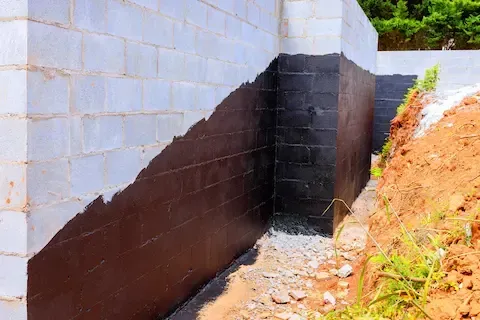
Positive-side waterproofing is applied to the exterior face of the foundation wall — the side in contact with soil. This is the most effective approach because it stops water before it reaches the concrete. Methods include sheet membranes, fluid-applied membranes, and drainage board systems. When a foundation excavation is open during new construction or during a major repair, this is the preferred approach and the one used by experienced crews working on Oregon City's hillside properties.
Negative-side waterproofing is applied to the interior face of the foundation wall. This approach does not stop water from entering the concrete, but it resists hydrostatic pressure and prevents water from passing through into the interior space. Crystalline products and hydraulic cement applications are the most common negative-side methods. Interior French drain systems are often paired with negative-side waterproofing as a drainage management strategy.
Drainage is an integral part of any foundation waterproofing system. In Oregon City, where heavy clay soils on many residential lots restrict percolation, proper footing drains, gravel backfill, and downspout extensions are as important as the membrane itself. A waterproofed foundation wall surrounded by saturated clay with no drainage path will eventually fail regardless of the coating quality.
Timing and Weather Windows for Sealer Application
Application timing is one area where Oregon City's climate requires more planning than in drier regions. Most sealers require dry surface conditions, and many require that air and substrate temperatures remain above 50°F during application and for a curing window afterward. In practical terms, this limits ideal sealing windows to late spring through early fall — approximately May through September.
Surface moisture is the critical variable. Even on a dry day in October, shaded concrete on north-facing exposures or under tree canopy may hold moisture from recent rain. Testing with a moisture meter or the simple plastic sheet test — taping a 12-inch square of plastic to the surface and checking for condensation after an hour — helps confirm readiness. Applying a film-forming sealer over damp concrete traps moisture and causes adhesion failure, cloudiness, or peeling within the first wet season.
For new concrete, the waiting period before sealing is equally important. Freshly poured slabs need time to cure and off-gas. Most specifications call for at least 28 days before applying a penetrating sealer and longer before applying film-forming products. Rushing this step in the weeks after a new driveway or patio pour is a common mistake that leads to adhesion problems and premature sealer failure.
Common Mistakes in Concrete Sealing Projects
Oversaturation during application is one of the most frequent errors. More sealer is not better — penetrating sealers need only enough product to reach saturation point at the surface, and excess product that cannot absorb will pool and cure as a white, tacky film. Following manufacturer coverage rates and using a second thin coat only if absorption warrants it produces better results than one heavy pass.
Surface preparation failures account for a large percentage of sealer longevity complaints. Oil stains, existing sealer residue, efflorescence, and form release compounds all interfere with adhesion or penetration. Pressure washing is a starting point, but contaminated surfaces often require degreasing, acid etching, or mechanical grinding before a new sealer will bond properly. Skipping prep steps to save time costs significantly more in early reapplication.
Applying the wrong product to the wrong surface is another pattern worth addressing. Using an interior epoxy coating on an exterior driveway, or applying an acrylic sealer to a below-grade wall, produces predictable failures. The Oregon City climate amplifies these mismatches because moisture exposure is consistent and prolonged. Matching product to application type and surface profile matters more here than in dry climates where poor choices might survive longer before failing visibly.
Annual Maintenance Practices That Extend Sealer Life
Sealed concrete is not maintenance-free, but its annual care requirements are manageable. At the start of each wet season — typically late September or early October in the Oregon City area — inspect all sealed surfaces for areas where the sealer is failing. Film-forming sealers show failure as peeling, whitening, or a lack of water-beading response. Penetrating sealers are harder to assess visually; the water bead test is the most reliable indicator of active protection.
Cleaning debris promptly matters more in a wet climate. Leaves and organic material left on sealed concrete trap moisture and create conditions favorable to mold and mildew growth. Fall cleanup before the rainy season, particularly on patios and pool decks near trees, extends both sealer life and surface appearance.
Joint sealants between slabs and at control joints should be inspected at the same time. Failed caulk in these locations allows water to undercut slab edges and reach the base material, causing the settlement and edge cracking that makes driveways age faster than the concrete itself should. Replacing joint sealant is an inexpensive maintenance step that protects a much larger investment.
If you're working through a larger concrete project that includes grading or soil retention, reviewing the considerations around drainage design for retaining walls helps you understand how surface water management and waterproofing decisions interact on sloped lots. Getting drainage right before sealing flatwork is the sequence that produces lasting results.
Working With a Local Contractor on Sealing and Waterproofing
Concrete sealing and waterproofing projects in Oregon City range from straightforward driveway maintenance to complex foundation remediation requiring excavation and drainage system installation. The appropriate scope depends on what the surface or structure is showing, how long it has been unprotected, and what the site drainage conditions look like.
A qualified local contractor will assess surface moisture, existing sealer condition, substrate soundness, and site drainage before specifying a product or system. For foundation work on Clackamas County hillside properties, that assessment should include evaluation of soil type, slope, and existing drainage infrastructure. Applying a waterproofing membrane to a wall that is carrying hydrostatic pressure from poorly managed drainage solves only part of the problem.
For exterior flatwork — driveways, walkways, patios — professional application provides access to commercial-grade products not available at retail, the equipment to apply them uniformly, and the surface preparation capability to make adhesion reliable. The difference in longevity between a properly prepared professional application and a DIY roller application on unprepared concrete is often measured in years, not months.
Whether you're maintaining an existing surface or starting a new project, connecting with a contractor experienced in local conditions is the most direct path to a result that holds through Oregon City's wet seasons. Professional concrete sealing services that understand the regional climate can specify and apply the right system for each application type, saving rework and extending the life of every concrete surface on your property.