Oregon City Commercial Concrete Right-of-Way Permits
Getting a commercial concrete right-of-way (ROW) permit in Oregon City, OR requires submitting an application to the Oregon City Public Works department, providing contractor licensing documentation, site plans, insurance certificates, and paying applicable fees before any work begins in the public right-of-way. Most straightforward applications are reviewed within 5 to 10 business days. Inspections are required at key stages, and all work must comply with Oregon City municipal code and ODOT standards where applicable. Working with a licensed contractor familiar with local requirements significantly reduces delays and the risk of permit rejection.
What Is a Commercial Concrete ROW Permit in Oregon City?
A right-of-way permit authorizes contractors and property owners to perform concrete work within publicly owned space — including sidewalks, curbs, gutters, driveway aprons, and curb cuts that fall between private property and the public street. In Oregon City, any commercial project that disturbs, replaces, or installs concrete within this zone requires a permit before work begins. This applies to new construction, tenant improvements that affect exterior access, and capital improvement projects along roads managed by Clackamas County or the city itself. Skipping this step can result in stop-work orders, required removal of completed work, and fines.
Who Needs to Apply for a ROW Permit?
In most cases, the licensed contractor performing the work submits the ROW permit application on behalf of the property owner or developer. Oregon City requires the applying contractor to hold a current Oregon Construction Contractors Board (CCB) license and carry general liability insurance with minimum coverage limits specified by the city. Some projects along state-managed corridors through Oregon City — such as sections of McLoughlin Boulevard — may also trigger an ODOT highway approach permit in addition to the city-level ROW permit. Confirm jurisdiction early so you are not managing two separate approval processes under deadline pressure.
What Documents Are Required for the Application?
Oregon City Public Works typically requires the following for a commercial concrete ROW permit application:
- Completed ROW permit application form from the Oregon City Public Works office or online portal
- Site plan or drawing showing the location, dimensions, and scope of proposed concrete work within the right-of-way
- Contractor CCB license number and proof of current registration
- Certificate of insurance naming the City of Oregon City as an additional insured
- Traffic control plan if work affects vehicle lanes, parking, or pedestrian access on public streets
- Permit fee payment based on the project scope and linear footage or square footage affected
For projects near historic downtown Oregon City or within the McLoughlin Conservation District, additional review by the planning department may be required before Public Works issues the ROW permit. Factor this into your project schedule if your site falls in those zones.
What Inspections Are Required During the Work?
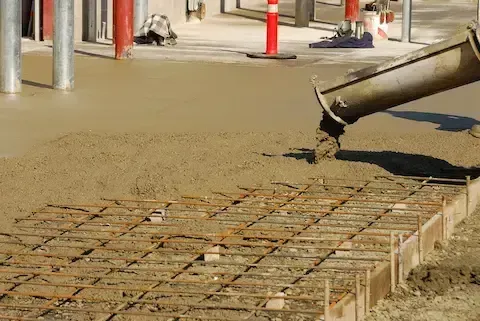
Oregon City Public Works inspectors typically require at least two inspection points for commercial concrete ROW work. The first is a pre-pour inspection confirming subgrade preparation, form placement, reinforcement if required, and conformance with approved plans. The second is a final inspection after curing to verify surface finish, cross-slope for ADA compliance, and joint placement. Inspectors may also require a forms inspection separately from the pre-pour if the project involves complex curb geometry or ADA curb ramp construction. Schedule inspections through Oregon City's permit portal or by contacting Public Works directly — failing to call for inspections before pouring is one of the most common causes of failed finals and required re-work on commercial ROW projects in the city.
How Long Does ROW Permit Approval Take in Oregon City?
Standard commercial concrete ROW permit applications in Oregon City are typically processed within 5 to 10 business days when submitted with complete documentation. Complex projects — those involving traffic signal infrastructure, storm drainage modifications, or coordination with Clackamas County road maintenance — may require additional review time of 15 to 30 business days. If you are working under a construction schedule tied to a commercial opening date or city deadline, submit your ROW permit application as early as possible. Last-minute submittals are a leading cause of project delays on commercial concrete work throughout the Oregon City corridor. For guidance on scheduling concrete pours around your permit timeline, the summer commercial concrete pour guide covers seasonal factors that affect pour timing and quality.
What Are the Most Common Reasons ROW Permit Applications Are Rejected?
Oregon City Public Works most frequently rejects or delays commercial concrete ROW applications for these reasons:
- Missing or expired CCB license documentation submitted with the application
- Insurance certificates that do not name the City of Oregon City as an additional insured party
- Site plans that lack dimensions or fail to show property lines relative to the proposed work area
- No traffic control plan submitted for work adjacent to travel lanes or shared-use paths
- Incomplete fee payment or payment submitted without the application form
Reviewing the current Oregon City ROW permit checklist before submitting — available from the Public Works department — prevents the majority of these issues.
Do ADA Requirements Apply to ROW Concrete Work in Oregon City?
Yes. Any commercial concrete work within the Oregon City right-of-way that involves pedestrian access — including sidewalks, curb ramps, driveway aprons, and crosswalk approaches — must comply with current ADA standards and the Oregon Revised Statutes accessibility requirements. Curb ramp geometry, running slope, cross-slope, landing dimensions, and detectable warning surface placement are all reviewed during inspection. ADA non-compliance is a common cause of failed finals on commercial projects throughout Clackamas County. Contractors performing commercial concrete work in the ROW should verify all ramp and sidewalk dimensions against current PROWAG guidelines before forming.
What Happens After the Permit Is Closed?
Once your final inspection passes and Oregon City Public Works closes the ROW permit, the city maintains the right to inspect the work for a defined warranty period — typically one to two years for concrete flatwork installed in the public right-of-way. If the concrete fails, settles, or shows significant cracking within that period, the contractor of record may be required to perform repairs at no cost to the city. This is why material quality, subgrade preparation, and proper curing during the original pour matter as much as permit compliance itself on commercial ROW projects in Oregon City.